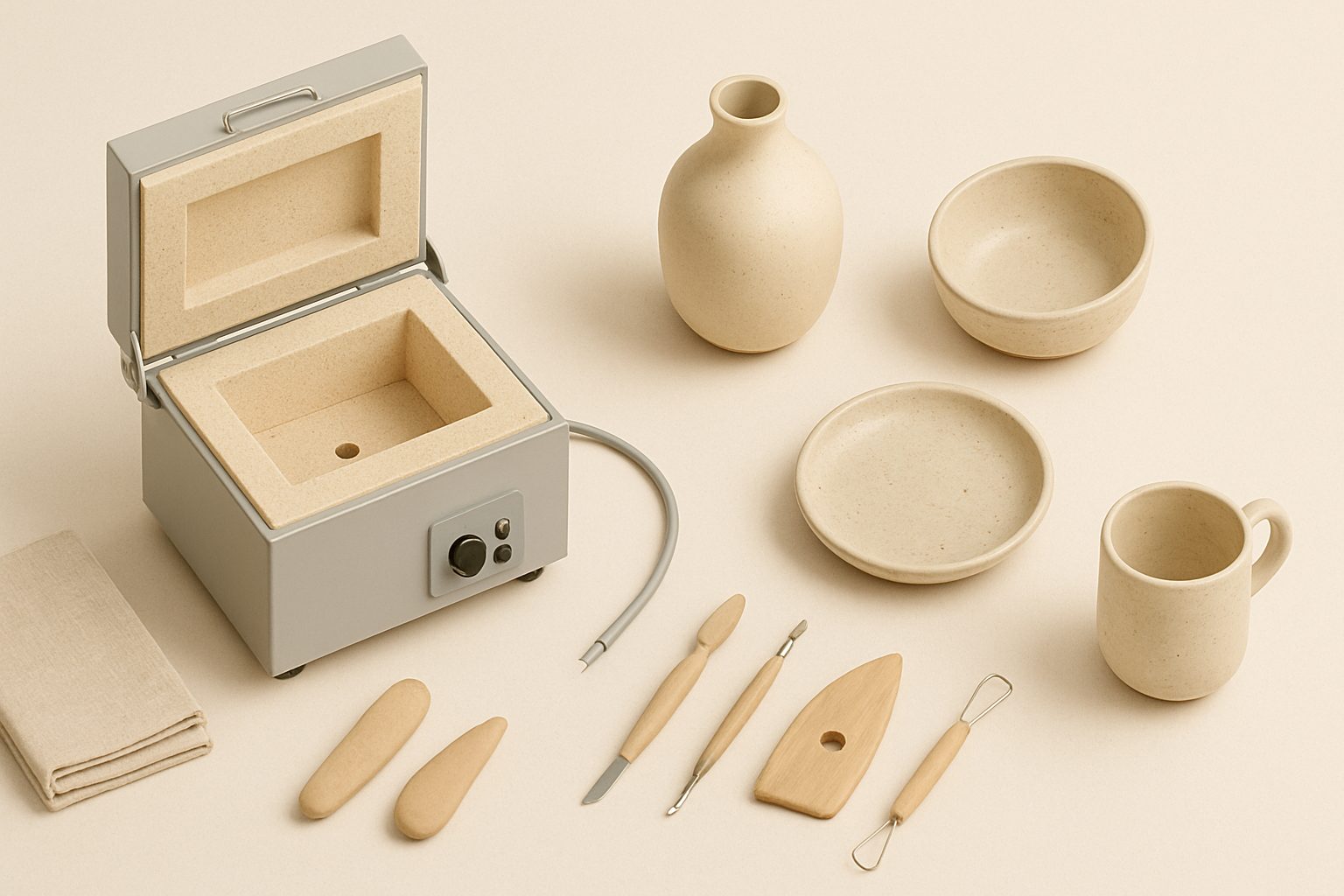
Best Tabletop Pottery Kilns UK – Top-Rated Countertop Models Reviewed
Living in a flat doesn't mean you have to abandon ceramics. Tabletop pottery kilns have made studio-quality firing accessible for urban potters, and if you're working in a small space, finding a reliable countertop model that runs on household electrics is the difference between a serious hobby and an impossible dream.
The challenge for UK flat-dwellers is power. Most kilns demand three-phase industrial supply or expensive heavy-duty installations. But a handful of modern tabletop models run on standard 13-amp sockets—enough to fire small pieces without rewiring your kitchen. We've tested and reviewed the three most practical options currently available in the UK market: the Skutt Firebox, Paragon SC-2, and Rohde Speedy.
What makes a tabletop kiln practical for flats?
Tabletop kilns are compact—typically 40-60cm wide—and weigh 25-45kg, meaning you can set one on a sturdy shelf or wheeled stand. The real constraint is electrical. A 13-amp socket in the UK supplies 3,000 watts maximum. Most tabletop models max out around 2,500-3,000W to stay within that limit, though they can't run at full power continuously without tripping your electrics or causing voltage drop through your entire flat.
Firing times are longer than larger kilns (typically 8-14 hours to reach 1,200°C), but the fuel cost per cubic centimetre is competitive, and the small internal volume—usually 15-25 litres—means you get a meaningful amount of work done without astronomical heating bills.
Skutt Firebox
The Skutt Firebox is the smallest and most apartment-friendly of the three. It measures 38cm × 38cm × 38cm internally and fires to cone 04–6 (1,060-1,300°C). Power draw is 1,500W on its standard controller, rising to 2,500W if you add their optional enhanced element.
Strengths: Skutt is reliable American manufacturing; the kiln is nearly silent during firing and runs cool on the exterior (safe for tabletops with heat-sensitive furnishings nearby). It fires in around 10 hours to cone 6, and spare parts are readily available through UK distributors. The controller is intuitive, and firing schedules can be saved to memory.
Weaknesses: It's the smallest chamber, so you're limited to small to medium pieces. Unglazed ware fires better than glazed—the chamber tends to cool unevenly in the corners, occasionally producing kiln spots. Bisque firing works beautifully. The price sits at around £1,400–1,600 fully assembled, which is the highest entry point of the three.
13-amp suitability: Excellent. At 1,500W standard, it won't tax an average domestic circuit. It's the safest choice if your flat is on older wiring.
Paragon SC-2
The Paragon SC-2 splits the difference. It's 51cm × 51cm × 36cm internally, offering more chamber volume than the Firebox whilst staying on a 13-amp supply. Fires to cone 6, with a maximum power draw of 2,800W on full elements.
Strengths: Better interior space means taller pieces and more work per firing. Paragon's digital kiln sitter (their version of a limit switch) is dependable; the kiln fires evenly, and glazed work comes out consistent. Bisque and glaze both fire predictably. Heating element access is straightforward if you ever need to replace one. UK support is solid through specialist suppliers.
Weaknesses: It's heavier (around 42kg) and definitely needs a dedicated stand. At 2,800W, it will draw near the upper limit of a 13-amp circuit when fully powered—not safe to run alongside other high-draw appliances. Firing times stretch to 12-14 hours for a full glaze cycle. The price is moderate: around £1,200–1,400.
13-amp suitability: Marginal. It works on a standard socket, but you can't run the kettle, washing machine, or electric heater simultaneously without risk. Best suited to a dedicated circuit or homes with robust mains supply.
Rohde Speedy
The Rohde Speedy is the budget option and, surprisingly, the quickest. At 45cm × 45cm × 35cm, it fires to cone 6 in around 8-10 hours thanks to superior insulation. Power demand peaks at 2,400W but averages lower during the firing cycle.
Strengths: Fastest firing times mean lower energy cost per piece. Build quality is solid German engineering—the exterior stays remarkably cool due to the insulation. It's the least expensive option at £900–1,100, making it the easiest entry point. The compact size doesn't compromise internal space much. Spare parts availability is good across UK hobby pottery suppliers.
Weaknesses: The smaller price tag comes with less-sophisticated temperature control—no programmable controller; it's a simpler limit-switch design that works but offers less flexibility for custom firing schedules. Some users report the burners (if you opt for their gas version) are temperamental; stick with the electric model. Documentation is sparse, and UK technical support is slower than Paragon or Skutt.
13-amp suitability: Acceptable, though similar to the Paragon—use a dedicated circuit if possible. It's the best compromise between cost and practicality.
13-amp supply: real expectations
Honest assessment: none of these kilns should be your flat's only high-power appliance running during a firing cycle. A dedicated radial circuit from your consumer unit is ideal—a cheap fix (£80–150 in labour) that a qualified electrician can add in under an hour. If that's not possible, check your flat's total amperage (older properties: 60A; newer: 100A+) and trial-fire during off-peak hours.
Modern thermal cuts will shut down if your supply voltage drops too far. If your lights dim when the kiln reaches temperature, your supply isn't stable enough, and you risk incomplete firings or damage.
Which is right for you?
Choose the Firebox if you're in a listed flat with difficult electrical access and you prioritise safety above all else. Choose the Paragon if you want space for bigger work and you can arrange a dedicated circuit. Choose the Rohde if you're budget-conscious, fire frequently, and can work with fixed schedules.
All three are genuinely worth the investment and will serve serious potters for a decade with minimal maintenance.
More options
- Electric Ceramic Kilns – Full Range (Amazon UK)
- Programmable Kiln Controllers (Amazon UK)
- Kiln Furniture & Shelves (Amazon UK)
- Kiln Vent & Fume Extraction Systems (Amazon UK)
- Jewellery & Small Specialty Kilns (Amazon UK)