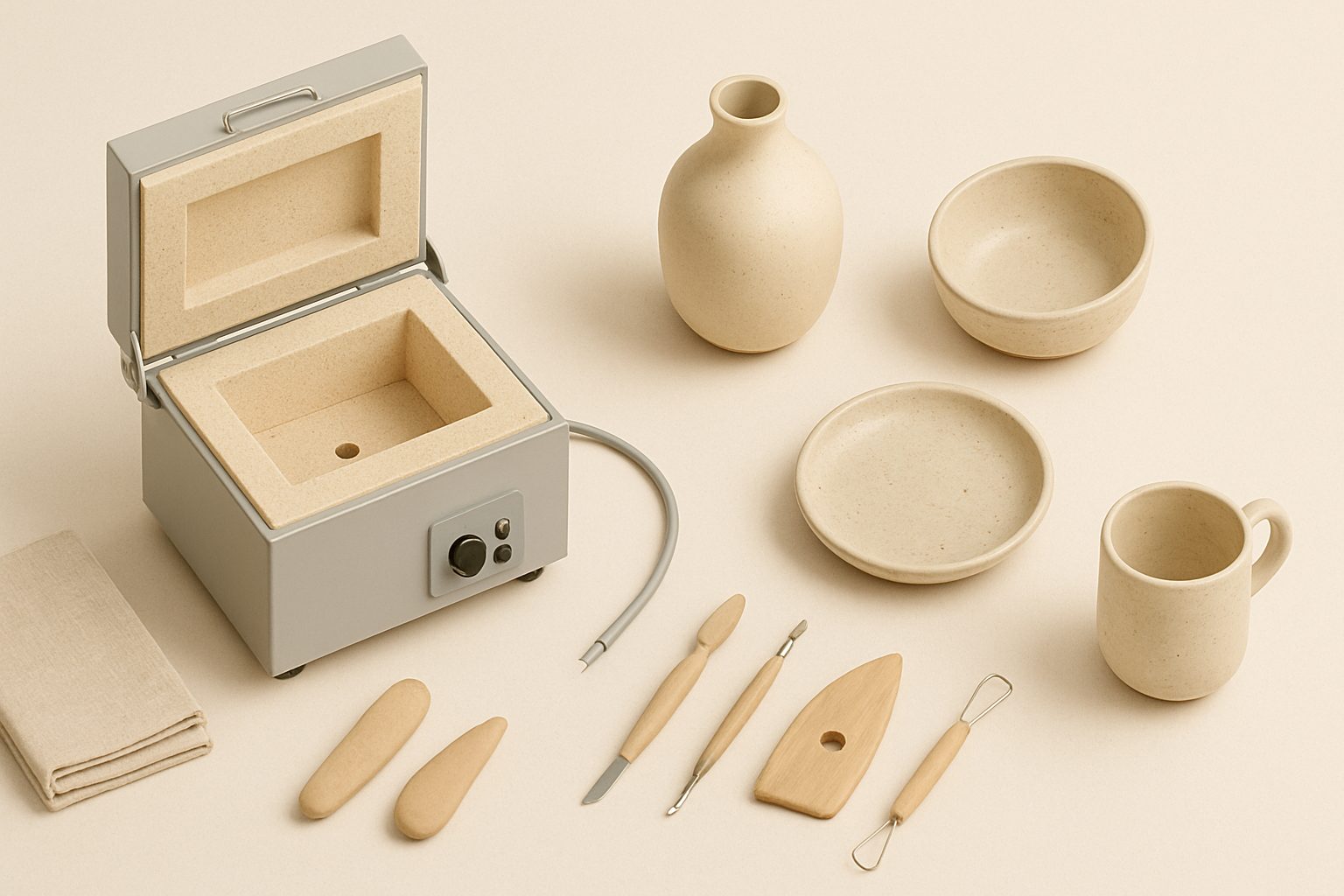
Best Kilns for Schools and Home Workshops UK – Durable Mid-Size Options
Schools and active home ceramics workshops face a particular challenge: you need a kiln robust enough for frequent firing but sized to fit realistic workshop spaces and power supplies. The traditional choice between tiny hobby kilns and full-size studio equipment leaves a genuine gap. Mid-size front-loading kilns bridge that gap, offering the durability and chamber volume to support multiple users and heavier firing schedules without demanding massive infrastructure.
Why Front-Loading Kilns Work for Shared Spaces
Front-loading designs dominate educational and commercial ceramics studios for straightforward practical reasons. Vertical loading is slower and less ergonomic in high-turnover workshops — you're lifting ware overhead repeatedly throughout the day, which becomes fatiguing and increases breakage risk. Front-loaders let you stack shelves at waist height, move them in and out as complete units, and inspect ware easily without reaching.
The thermal mass in a properly built mid-size front-loader also suits frequent firing. These kilns retain heat efficiently between cycles, so your running costs per firing drop compared to lighter hobby models. Doors seal well on established brands, minimising heat loss and reducing the temptation to prop them open during loading — a habit that damages both elements and bisque ware.
Single-Phase versus 3-Phase: The UK Electrical Reality
This decision matters more in the UK than marketing materials suggest. Most homes and small workshops run on single-phase supply, but the power ceiling is real.
Single-phase supply tops out at around 13 amps in domestic installations (3 kW); some small commercial units allow 16 amps (3.7 kW). Many mid-size kilns draw 6–9 kW at peak heating and cannot run on domestic circuits. Even if you install a higher-rated isolator switch, your DNO-approved supply may not deliver sustained power. Running underpowered kilns extends firing times unpredictably and stresses heating elements.
3-phase supply is standard in older commercial buildings, schools, and larger workshops, but absent from most residential properties. Installation costs £2,000–£5,000+ for a domestic upgrade. Kiln builders offer 3-phase models precisely because three-phase distributes load more evenly, stabilises voltage, and reduces element strain. If your workshop already has 3-phase (check your fusebox or ask your electrical installer), a 3-phase kiln is the sensible choice.
For schools, three-phase is usually present already. Check with your estates team before committing to any kiln.
The Rohde Ecotop 43: German Build Quality
The Ecotop 43 is a compact front-loader with genuine mid-size credentials: 85 litres working volume, roughly 60 cm wide. It fires to cone 10 (1300 °C) and holds steady temperatures reliably, making it suitable for stoneware and high-fired earthenware production.
Build quality is notably thorough. The firebrick is dense, the element grooves are properly spaced, and the steel frame is thicker than budget alternatives. Rohde kilns are modular — you can replace elements, door seals, or shelving without major faffing. In UK schools particularly, this repairability matters. You don't want downtime waiting for replacements that take weeks to ship from Germany.
The Ecotop 43 is available in both single-phase (if you can manage 9 kW sustained) and 3-phase versions. Performance is even across both, but honestly, the single-phase version is tight for fast turnover. Firing cycles extend if the supply dips or if multiple circuits share the load. In a school setting with multiple users, single-phase can frustrate schedules.
Drawbacks: price sits in the upper mid-range. Repairs require Rohde parts or specialist knowledge — local potters' repair networks won't cover all issues. The interior can feel snug if you're used to larger chambers.
The Skutt KM-1027: American Reliability
Skutt specialises in educational kilns and shows it. The KM-1027 is a front-loader with 83 litres of usable space, fires to cone 10, and comes in single and 3-phase models.
Skutt's real strength is spares availability and customer support. Hit a problem and you can phone their support line and get a human who understands your setup. Replacement elements, shelving, and door components are stocked by UK ceramic suppliers. For schools with limited technical staff, this accessibility is genuine peace of mind.
Skutt kilns are built with standard components. The elements are nichrome wire on standard grooves — not proprietary. If a repair specialist knows kilns, they know Skutt. That's less true for some imported European brands.
The KM-1027 fires reliably and consistently. Usuarios report long element life if the kiln isn't run at absolute maximum power constantly, which isn't necessary for good results anyway. The control systems are simple and durable.
Downsides: the exterior gets hot — hotter than the Rohde — so placement matters in small workshops. The single-phase 9 kW version again feels marginal for frequent use. Skutt doesn't quite match Rohde's build solidity in the firebrick itself, though it's still well above hobby-kiln standard.
Cooling and Workshop Infrastructure
Don't underestimate cooling and space. Both these kilns reach 80–100 °C on the exterior at full temperature. A school kiln room needs decent ventilation or your space becomes genuinely uncomfortable. Extract ducting is recommended, not optional. Budget £500–£1,000 for installation if it doesn't exist.
Mid-size kilns also need stable flooring and level placement. Uneven kiln placement stresses door seals and can cause warping. Concrete or solid wooden floors work. Thin chipboard flooring in older buildings sometimes needs reinforcement.
Making the Choice
Pick 3-phase if you have it — both kilns perform better and future-proof your workshop. If limited to single-phase, honestly, look for smaller kilns unless your electrical installer confirms 16 amp capacity with stable voltage.
Between Rohde and Skutt, consider your support network. Schools often favour Skutt's easier repair pathways. Private workshops with technical confidence gravitate toward Rohde's build robustness. Both fire exceptional work and both last 15+ years with basic maintenance.
The true cost of ownership includes element replacement (roughly £400–£600 every 5–8 years with heavy use), annual servicing checks, and possibly door seal refurbishment. Budget for this before you buy. A kiln that sits unused because repairs feel too complicated or costly isn't saving you money.
More options
- Electric Ceramic Kilns – Full Range (Amazon UK)
- Programmable Kiln Controllers (Amazon UK)
- Kiln Furniture & Shelves (Amazon UK)
- Kiln Vent & Fume Extraction Systems (Amazon UK)
- Jewellery & Small Specialty Kilns (Amazon UK)