Best Kilns for Jewellery Making at Home UK – PMC, Enamelling & Glass Fusing
Jewellery making at home has opened up dramatically thanks to affordable kilns designed for small-scale work. Whether you're fusing glass, firing polymer metal clay (PMC), or enamelling copper, you need a kiln that heats fast, holds temperature precisely, and doesn't dominate your workspace. Standard ceramic kilns are oversized and inefficient for this work. Specialist jewellery kilns are built around the specific thermal demands of these techniques.
What Makes a Jewellery Kiln Different
Jewellery kilns differ from pottery kilns in three critical ways. First, they heat rapidly—reaching 800°C in minutes rather than hours. This matters because PMC, glass fusing, and enamelling work requires quick turnaround and predictable results. Second, they maintain tight temperature control, often to within ±5°C, because techniques like glass fusing are sensitive to heat curves. Third, they're compact: 30–60 cm wide, fitting on a bench or in a cupboard.
You'll also notice jewellery kilns use less power than studio ceramic kilns. Most run on standard UK domestic electricity (13A plug), whereas larger pottery kilns often need rewiring or three-phase supply. This matters if you're working from a spare room or small studio.
Kiln Types for Home Jewellery Work
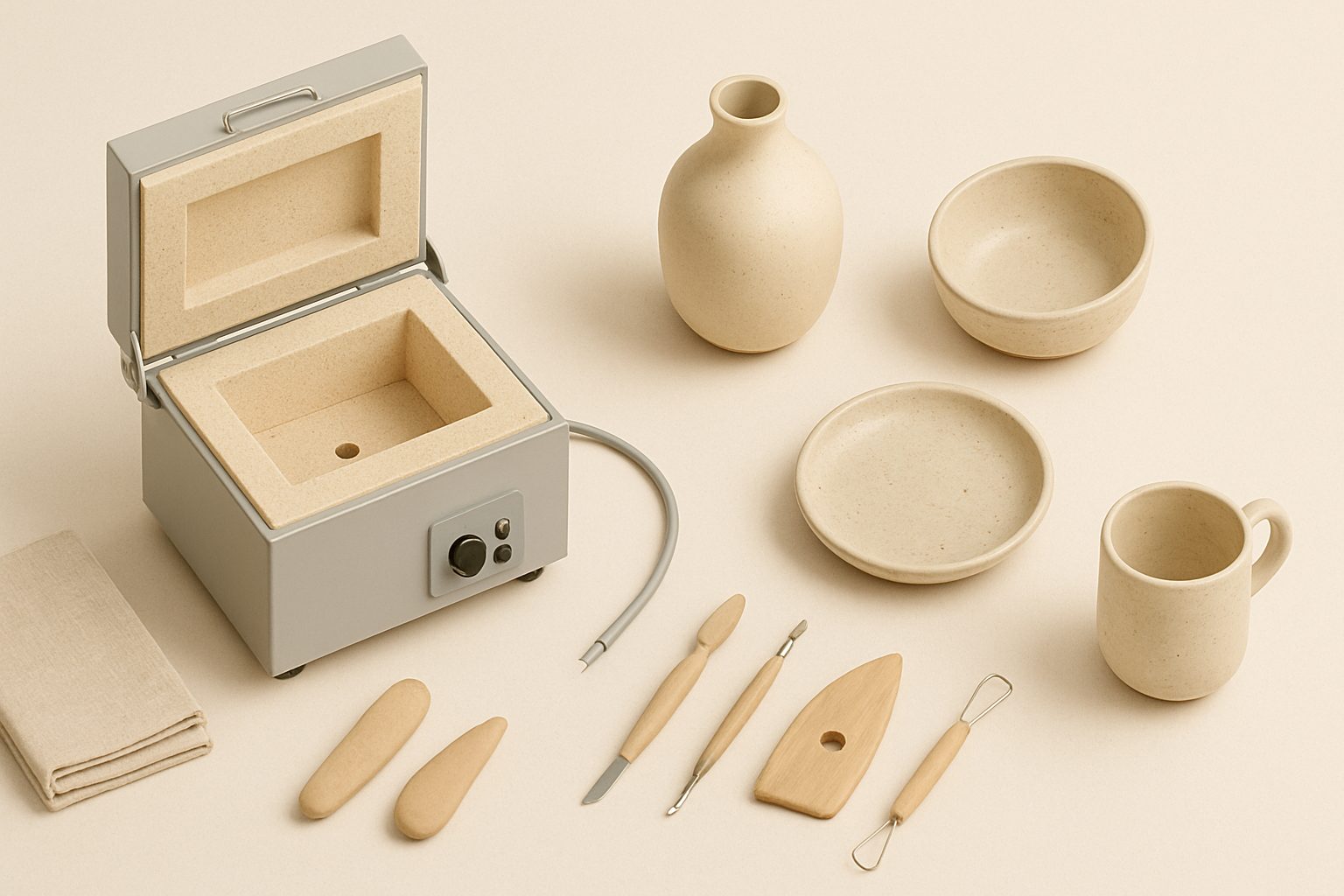
Front-loading kilns are the most versatile for mixed jewellery work. They sit upright, roughly the size of a microwave, and load from a hinged front door. You can see inside as you work and remove items easily. The thermal chamber is small, so heat distributes evenly. Most models reach 1200–1300°C, covering PMC (1200°C), enamelling (750–850°C), and soft glass fusing (900–950°C). Downsides: they don't cool quickly, so you'll wait 1–2 hours for work to come out; and they're not ideal if you need to fire large flat sheets.
Top-loading kilns are less common for jewellery but useful if you're doing high-volume enamelling. You load work into a basket lowered into the top. They heat and cool slightly faster than front-loaders because the opening is smaller. The narrower chamber means less even heat distribution, which matters less for small items.
Kiln furnaces (open-front designs) are specialist tools for PMC work. They sit on a bench, heat from above and below, and you insert work on a shelf at eye level. They cool very fast—15 minutes to handle-hot. The trade-off: they're expensive, less versatile than front-loaders, and can have uneven temperature zones.
Microwave kilns exist but are overstated. They're genuinely useful only for small enamelling on silver findings or quick testing. They can't reliably reach the temperatures needed for glass fusing or PMC.
Key Specifications to Compare
Temperature range and accuracy are the foundation. Check the maximum temperature and, crucially, whether the kiln holds ±5°C at your target temperature. Budget models drift by 20–30°C, which ruins glass fusing work. Mid-range kilns with digital controllers are worth the extra cost here.
Heat-up time directly affects your workflow. A kiln that reaches 1000°C in 30 minutes is dramatically faster than one taking 90 minutes. Check the spec, not just assumptions—wattage and kiln volume matter.
Chamber size should fit your typical load. If you're enamelling jewellery, you need space for 20–30 pieces but don't benefit from a cavernous chamber. A 30 × 30 × 30 cm chamber is standard for home work; anything larger is overkill and wastes energy.
Cooling rate is underrated. Fast-cooling kilns let you get results quickly but can stress PMC if it cools unevenly. Check whether the kiln has ventilation holes and how quickly it naturally cools. Some designs cool in 45 minutes; others take 3 hours. For frequent work, faster cooling saves time.
Power consumption matters for UK homes. Most specialist jewellery kilns draw 3–4 kW, fine on a standard circuit. Some premium models draw up to 6 kW. Check your electrics before buying.
Practical Considerations
Ventilation is essential. Firing PMC releases binder gases; enamelling releases flux fumes. You'll need the kiln near a window or extractor, or running under a hood. Many UK users site kilns in kitchens (after cooking) or utility rooms. Avoid living spaces without extraction.
Bench space is usually tight in UK homes. A 50 cm kiln plus heat-proof surround needs roughly 1.5 m² of stable bench space. Kilns aren't light—expect 40–60 kg—so permanent placement is best.
Cost of ownership includes the kiln itself (£400–£2000), controller upgrades (often £100–£400 extra), and electricity. A typical firing costs £2–£5 in power, depending on programme length and kiln size. Factor in replacement elements every 3–5 years (£150–£400).
Thermocouple replacement is a minor but regular maintenance task. Most kilns need a new thermocouple every 2–3 years, costing £30–£80. Budget models sometimes make this hard; quality brands make it straightforward.
Who Should Buy What
If you're starting PMC work, a mid-range front-loader (1200°C, digital controller, 40 cm chamber) is the safest choice. It handles PMC, enamelling, and soft glass equally well, even if you're not brilliant at programme control yet.
For pure enamelling on existing jewellery, a smaller, faster kiln is reasonable—you don't need 1200°C, just reliable holding at 800°C.
For serious glass fusing, you need a kiln with proven temperature stability and a good track record. Cheap kilns with proportional controllers (non-digital) often can't hold a fusing ramp steadily, ruining work.
Reality Check
No home kiln is perfect. Fast heat-up is brilliant for workflow but means you need to manage cool-down. Compact size saves space but limits batch sizes. Budget kilns are tempting but often mean wasted material as you learn their quirks. Mid-range models, with digital controllers and established reputations, tend to deliver the best value for UK home jewellers. Expect to spend £800–£1500 on a kiln that genuinely lasts and delivers consistent results.
More options
- Electric Ceramic Kilns – Full Range (Amazon UK)
- Programmable Kiln Controllers (Amazon UK)
- Kiln Furniture & Shelves (Amazon UK)
- Kiln Vent & Fume Extraction Systems (Amazon UK)
- Jewellery & Small Specialty Kilns (Amazon UK)